
Society will need new institutions for a world with powerful AI, and there are very few concrete proposals.
The researchers who could produce them exist. They work across mechanism design, political philosophy, social choice theory, legal scholarship, and AI governance. They disagree productively with one another, and when they are in the same room — at the Paris workshop on AGI-ready institution design in February, for example — the overlap of concerns is striking. But the work they could do has, for the most part, not been written.
Part of the reason is that there is no venue whose mission is to pull it into existence and make it cumulative. You can publish on these themes in a journal or a magazine, but nowhere that functions as the ongoing, public debate: a place that actively elicits proposals, puts them in front of the right critics, and treats the back-and-forth as the point. What public debate does exist is mostly stuck at the level of doomers versus accelerationists — far below what the moment demands.
Pax Machina is an attempt at that venue. It publishes concrete institutional proposals and the critiques and extensions they provoke. The conversation building visibly over time — proposals, responses, refinements — is the point. Aspirationally, we’re building toward a body of designs rigorous enough to inform real institutional choices: something approaching a new social contract for the age of AI.
What we publish
Every piece engages substantively with how institutions should work in a world with powerful AI, with enough specificity that someone could act on it or argue with it. Concretely:
- Proposals. A design for a new institution, or a substantial reform to an existing one.
- Responses. Short critiques and extensions — arguing a proposal won’t work under specific conditions, or repairing it, or offering an alternative.
- Analyses. How AI changes the design space for a class of institutions: antitrust when agents can collude, democratic process when the electorate can delegate, markets when the parties to a contract can be represented by AI.
- Roadmaps. What to watch, which capability thresholds make which institutional innovations pressing.
We are not a venue for diagnosis without proposal, for conventional AI regulation, or for opinion that doesn’t engage with specific mechanism. If an argument doesn’t name institutions specifically enough for someone to disagree with, it isn’t yet a Pax Machina piece.
Pieces here are explicitly working proposals. Authors retain the right to develop them into papers for peer-reviewed venues. We hope this lowers the cost of publishing serious work before the peer-review pipeline is willing to touch it.
The design space we’re mapping
To have concrete proposals, you need some map of where proposals can sit. One of us has sketched the following: a grid of seven informational bases that institutions organize around, ordered by the depth of shared understanding they require to work.
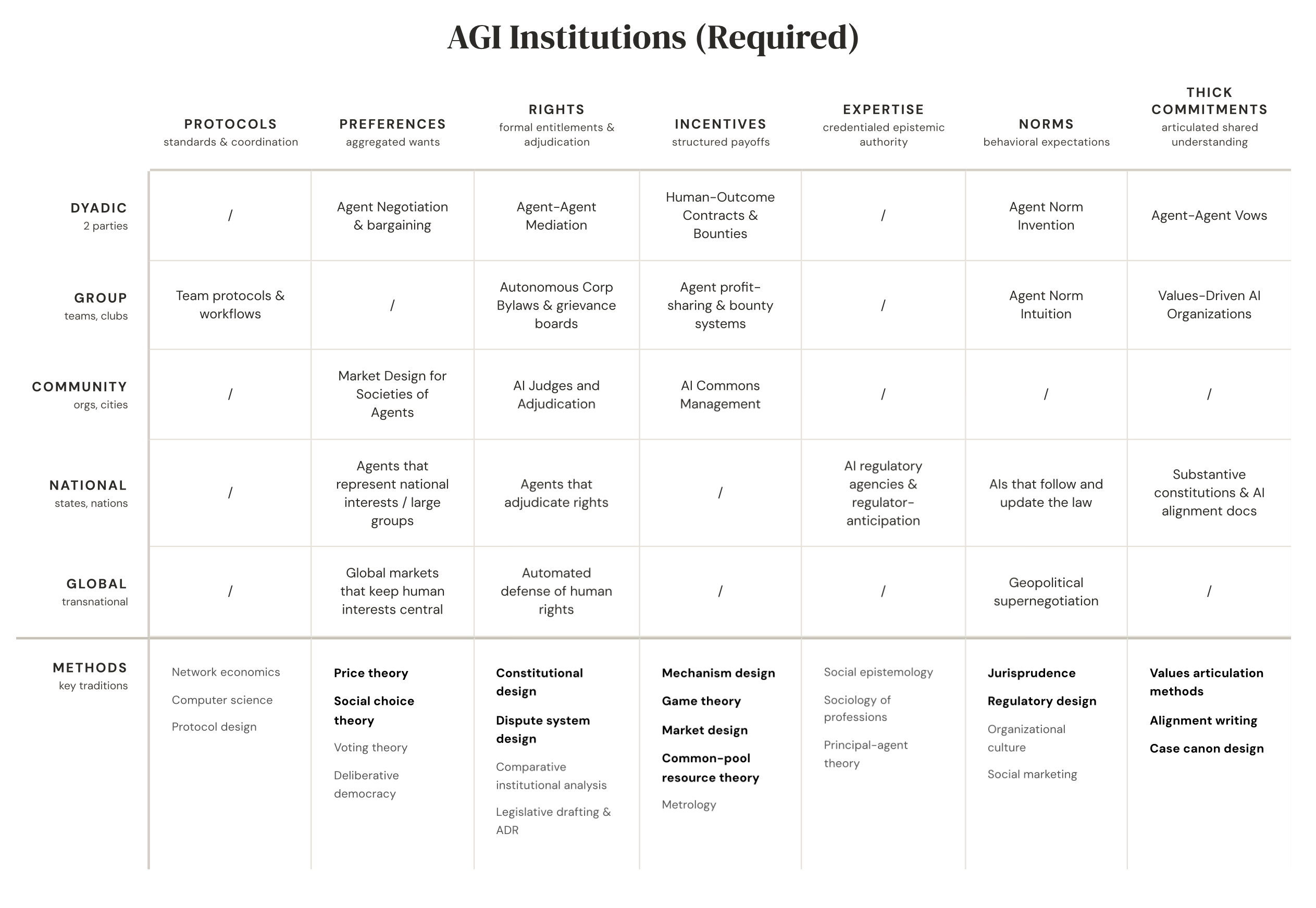
The institutions grid: seven informational bases, from thin (protocols) to thick (shared commitments), shown at five scales. Developed for the Paris workshop on AGI-ready institution design.
At the thin end of the grid are protocols — coordination forms that would work even with agents who share no values. Standards bodies, TCP/IP, smart contracts. Next are preferences, the mechanisms that aggregate what people want without asking them to justify it: elections, markets, prediction markets. Then rights — the binding articulations of what people are entitled to and how that gets enforced. Incentives — the deliberate structuring of payoffs to produce chosen outcomes. Expertise — institutions built on delegating judgment to those who know more. Norms — the encoded expectations that shape behavior without explicit rules. And, at the thick end, shared commitments — institutions that work because their participants have a rich, articulated sense of what matters.
What AI changes, at nearly every cell of this grid, is two things at once. First, what thinner mechanisms can do: markets can now clear outcomes rather than goods; elections can in principle aggregate reasons rather than votes; contracts can be enforced by representations of the parties’ values rather than letters of the agreement. Second, and harder, what scaling the thick end might finally become possible for: articulated commitments that were once the province of small communities with long-lived interpretive traditions can, in principle, be transmitted and interpreted at scale.
That second shift is where most of the open design questions live. It is also where most of the danger lives. The first issue of this publication is concerned with it directly.
Issue 01
This issue is anchored by a pair: a diagnosis and a proposed response.
In Value Drift in Institutions, Joe Edelman argues that institutions systematically drift from their stated purposes through three well-studied mechanisms — inarticulacy, self-scoring, and capture — and are increasingly trapped by a fourth that deserves a name of its own: value substitution loops, feedback cycles in which a whole ecosystem adapts to a proxy metric until no actor can revert to the original values without losing standing in the proxy-optimized system. The mechanism is general. It explains social media, but also academia, arts funding, medicine, journalism. It suggests that the standard tools for reversing drift — skin in the game, people who care — are failing against a specific and newly common failure mode.
Edelman’s companion piece, Freedom, Fairness, and Fidelity, is a first pass at a positive response: a new public value (fidelity) and a set of institutions that would implement it. He develops tools (thick models of value, moral graph elicitation, a combinatorial risk-sharing auction), property conditions tied to mandate, civic practices (apprenticeships and fidelity panels), and legal backstops (fidelity audits and courts) bounded by limiting doctrines. The proposal is unavoidably programmatic. We publish it that way on purpose. Concrete enough that you can agree, disagree, extend, or replace piece by piece — which is exactly what we want.
Future issues will carry responses to both pieces, and new proposals. We have commitments from several authors for Issue 02.
What we want from you
Two things.
If you are working on a proposal that fits — a concrete institutional design, a critique of one, an analysis of how AI changes the design space for some class of institution — we want to see it. The submissions page says how.
If a piece published here seems wrong to you, we especially want to hear from you. Responses are not an afterthought. They are half the format. We will find your critique a home faster than we will find a new proposal one.
More than anything, we want this publication to be something researchers are glad to be associated with: serious about the stakes, constructive about the work, hostile to white noise. That is what this moment asks for. We are rolling up our sleeves.
— The Editors
Pax Machina is edited by Ryan Lowe, Joe Edelman, and Oliver Klingefjord, with an editorial board drawn from across mechanism design, governance, philosophy, and economics. We plan to publish one to two pieces a month.
COMMENT
send us an email with your thoughts